
Data analyst roles attract hundreds of applicants per posting. Recruiters lean heavily on ATS filters to narrow the field before a human ever reviews a resume — and those filters are configured around very specific tools, methods, and terminology. A resume that says “data analysis experience” where the job description says “SQL, Python, and Tableau” will be filtered out regardless of how qualified the candidate is.
This template is built around how data analyst roles are actually screened in 2026: tool-specific keyword matching, ATS-first filtering, and recruiters who spend seconds deciding whether to read further.
What Makes a Data Analyst Resume ATS-Ready
ATS systems for data analyst roles filter on specifics. “Experienced with data tools” fails. “SQL (PostgreSQL, BigQuery), Python (Pandas, NumPy), Tableau” passes. Every tool, language, and methodology needs to be named precisely — and matched to the terminology used in the job description you are applying to.
Formatting is equally critical. Tables, columns, and graphics break ATS parsing even when your content is strong. The template below uses a clean single-column layout that parses reliably across Workday, Greenhouse, Lever, iCIMS, and other major ATS platforms.
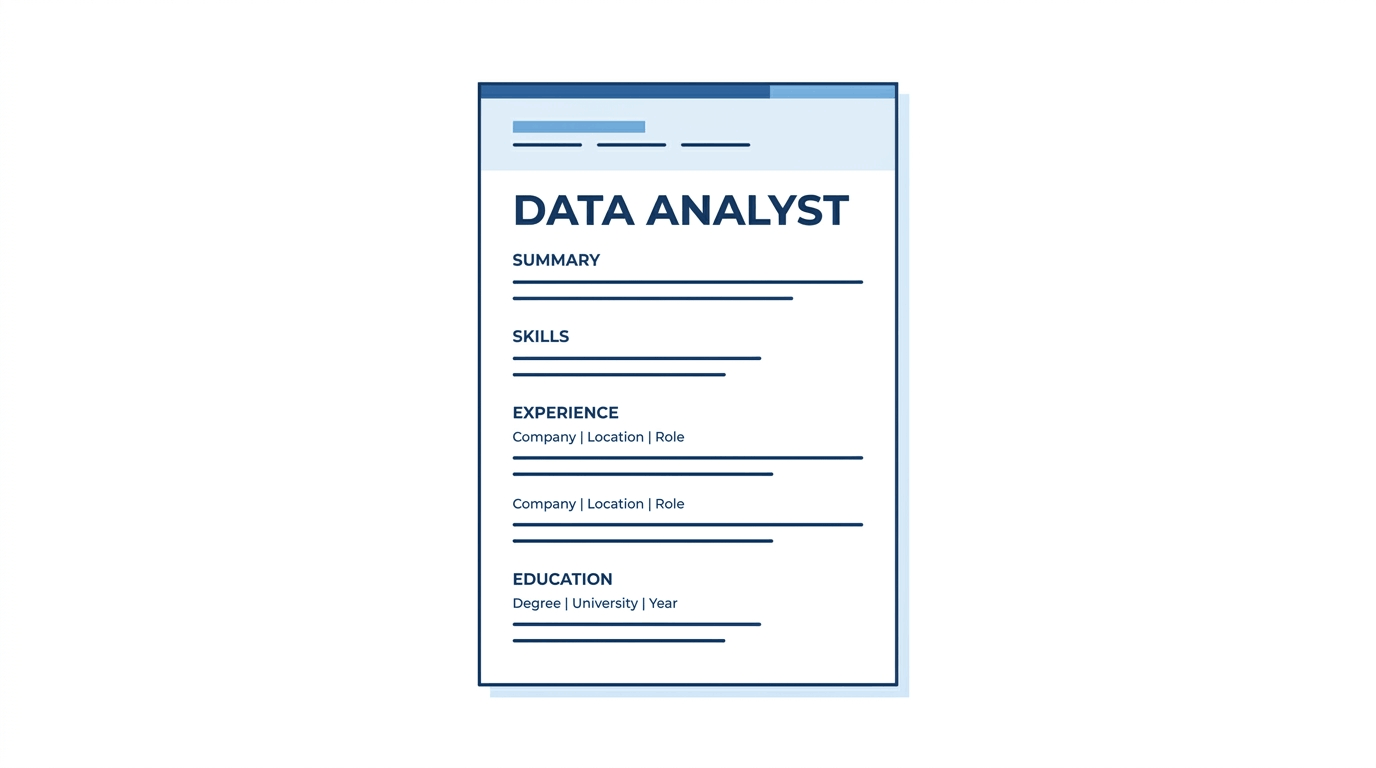
Data Analyst Resume Template
[Your Full Name] [City, Country] · [[email protected]] · [LinkedIn URL] · [GitHub or Portfolio URL]
Professional Summary
Data Analyst with [X] years of experience transforming complex datasets into actionable business insights. Proficient in [SQL / Python / R — match to job description] and experienced with data visualization tools including [Tableau / Power BI / Looker]. Track record of supporting data-driven decision making across [finance / marketing / operations / relevant domain]. Skilled in statistical analysis, data cleaning, and communicating findings clearly to both technical and non-technical stakeholders.
Skills
Languages & Querying: SQL (PostgreSQL, MySQL, BigQuery, Snowflake), Python (Pandas, NumPy, Matplotlib), R Data Visualization: Tableau, Power BI, Looker, Google Data Studio Databases & Storage: PostgreSQL, MySQL, MongoDB, Google BigQuery, Amazon Redshift Tools & Platforms: Excel (Pivot Tables, Power Query, VLOOKUP), Google Sheets, Apache Airflow, dbt Methods: Statistical Analysis, A/B Testing, Regression Analysis, Data Cleaning, ETL, Hypothesis Testing Other: Git, Jira, Confluence, REST APIs
Work Experience
[Job Title] — [Company Name], [City] | [Month Year] – Present
- Analyzed [type of data] across [X] datasets to identify [trend / insight], leading to [business outcome]
- Built and maintained [X] Tableau / Power BI dashboards used weekly by [X] stakeholders across [departments]
- Wrote complex SQL queries to extract and transform data from [database], reducing reporting time by [X]%
- Conducted A/B tests on [product / feature / campaign], resulting in [X]% improvement in [metric]
- Cleaned and preprocessed datasets of [X] million+ rows using Python (Pandas), improving data accuracy by [X]%
[Job Title] — [Company Name], [City] | [Month Year] – [Month Year]
- Developed ETL pipelines using [tool] to automate data ingestion from [X] sources, saving [X] hours per week
- Collaborated with cross-functional teams (marketing, product, finance) to define KPIs and build reporting frameworks
- Performed statistical analysis and hypothesis testing to validate [business decision], influencing [outcome]
- Presented data findings to senior leadership, contributing to [specific decision or initiative]
Projects
[Project Name] — [Link if public] [1–2 sentences describing the dataset, tools used, analysis performed, and measurable outcome or insight produced.]
[Project Name] — [Link if public] [1–2 sentences describing the project, methodology, and result.]
Education
[Degree] in [Field of Study — e.g. Statistics, Mathematics, Computer Science, Economics] — [University Name], [Year]
Certifications (if applicable)
- Google Data Analytics Professional Certificate
- Microsoft Certified: Data Analyst Associate (Power BI)
- Tableau Desktop Specialist
- [Other relevant certification]
Key ATS Keywords for Data Analyst Roles
The following are the most frequently required keywords in 2026 data analyst job descriptions. Include only those that genuinely reflect your experience, and use the exact phrasing from the job description wherever possible.
Querying & languages: SQL, Python, R, DAX, M Query
Specific SQL dialects: PostgreSQL, MySQL, T-SQL, BigQuery SQL, Snowflake SQL
Python libraries: Pandas, NumPy, Matplotlib, Seaborn, Scikit-learn
Visualization tools: Tableau, Power BI, Looker, Google Data Studio, Qlik
Cloud & data platforms: Google BigQuery, Amazon Redshift, Snowflake, Azure Synapse, Databricks
Methods & practices: Statistical analysis, A/B testing, hypothesis testing, regression analysis, data modeling, ETL, data cleaning, data wrangling, data governance
Soft skills that appear in JDs: Stakeholder communication, cross-functional collaboration, data storytelling, business intelligence
How to Tailor This Template to a Specific Job
A template is a starting point, not a finished product. Every version of your resume needs to be aligned to the specific role you are applying to. Here is how to do it efficiently:
1. Match their exact tool names. If the job says “BigQuery”, do not write “cloud databases”. If it says “Power BI”, do not write “data visualization tools”. Exact matches score higher in ATS systems.
2. Name your SQL dialect. Recruiters search for PostgreSQL, MySQL, BigQuery SQL, and Snowflake SQL as separate terms. “SQL” alone is weaker than naming the specific dialect the employer uses.
3. Name your Python libraries. “Python” without a library — Pandas, NumPy, Scikit-learn — fails ATS filters that search for specific skills. List the libraries relevant to the role.
4. Lead with domain-relevant experience. If the role is in finance, put finance-related bullet points first. If it is in e-commerce, lead with e-commerce data work. Recruiters want to see relevant context immediately.
5. Tailor your summary. Reference the specific domain, tools, and seniority level of the role in your first 3–4 lines. A summary written for the exact job you are applying to performs dramatically better than a generic one.
This process takes 30–60 minutes manually. CVjustify does it automatically — paste your resume and the job description, and it rewrites and aligns the full document in seconds.
Common Data Analyst Resume Mistakes
Listing tools without specifics. “Python” is weaker than “Python (Pandas, NumPy, Matplotlib)”. “SQL” is weaker than “SQL (PostgreSQL, BigQuery)”. ATS systems and recruiters search for specific tools, not category names.
No quantified impact. “Created dashboards” is not a bullet point — “built 5 Power BI dashboards used by 3 departments to monitor weekly KPIs” is. Every bullet should reference at least one of: volume of data, time saved, accuracy improved, revenue influenced, or stakeholder reach.
Mixing data analyst and data scientist signals. If your resume lists TensorFlow, PyTorch, and deep learning frameworks alongside “Data Analyst” as your title, ATS classifiers become uncertain about which role you are targeting and may rank you lower for both.
Ignoring Excel. Excel appears in roughly 80% of data analyst job descriptions. List specific functions — Pivot Tables, Power Query, VLOOKUP, INDEX-MATCH — not just “Microsoft Excel”.
Vague summary or no summary. The professional summary is the first section a recruiter reads after the ATS passes your resume through. Make it specific to the role, the domain, and the tools they are looking for.
Frequently Asked Questions
How long should a data analyst resume be?
One page for analysts with fewer than 7–8 years of experience. Two pages for senior analysts with extensive domain expertise. Prioritize relevant, recent experience — older or unrelated roles can be shortened or removed.
Should I include personal projects on my data analyst resume?
Yes — especially if they involve real datasets, published notebooks, or tools relevant to the role. Link to GitHub, Kaggle, or a portfolio site. A well-documented analysis project demonstrates initiative and practical skill.
Is Excel still relevant on a data analyst resume in 2026?
Yes. Excel appears in the majority of data analyst job descriptions. List specific capabilities — Pivot Tables, Power Query, VLOOKUP, INDEX-MATCH — rather than just “Microsoft Excel”.
Should I list Kaggle competitions?
If you placed in the top 20% of a competition, yes. If you merely participated, replace it with a more specific artifact — a published notebook, a reproducible repository, or a written analysis.
What format should I save my resume in?
PDF unless the job posting specifies otherwise. Some ATS platforms parse DOCX more reliably — if you are unsure, submit DOCX. Never submit as an image file or .pages format.
How do I make my resume pass ATS as a data analyst?
Use a clean single-column layout with no tables, text boxes, or images. Name every tool specifically, including SQL dialects and Python libraries. Mirror the exact keywords from the job description. Use standard section headers: Work Experience, Skills, Education. Save as PDF or DOCX.