
AI Engineer roles are among the fastest-growing and most competitive positions in the technology sector. The title spans machine learning engineering, MLOps, applied AI, generative AI, and LLM development — which means the applicant pool is highly specialized and ATS filters are configured to match very specific technical stacks. A resume that lists “experience with machine learning and AI” where the job description asks for “PyTorch, LLM fine-tuning, RAG pipelines, and MLOps with Kubernetes” will be filtered out before a recruiter ever sees it.
This template is built around how AI Engineer roles are actually screened in 2026: framework-specific keyword matching, model and tooling verification, and hiring managers who decide in seconds whether your technical depth maps to their requirements.
What Makes an AI Engineer Resume ATS-Ready
ATS systems for AI Engineer roles filter on a combination of frameworks, model types, cloud platforms, and domain-specific terminology. “Built machine learning models” fails. “Developed and deployed fine-tuned LLMs using PyTorch and Hugging Face Transformers, reducing inference latency by 40% via quantization and ONNX optimization” passes. Every framework, model architecture, cloud platform, and tooling stack needs to be named precisely — and matched to the language of the job description you are applying to.
Formatting matters equally. Tables, columns, text boxes, and graphics break ATS parsing even when your content is strong. The template below uses a clean single-column layout that parses reliably across Workday, Greenhouse, Lever, iCIMS, and all other major ATS platforms.
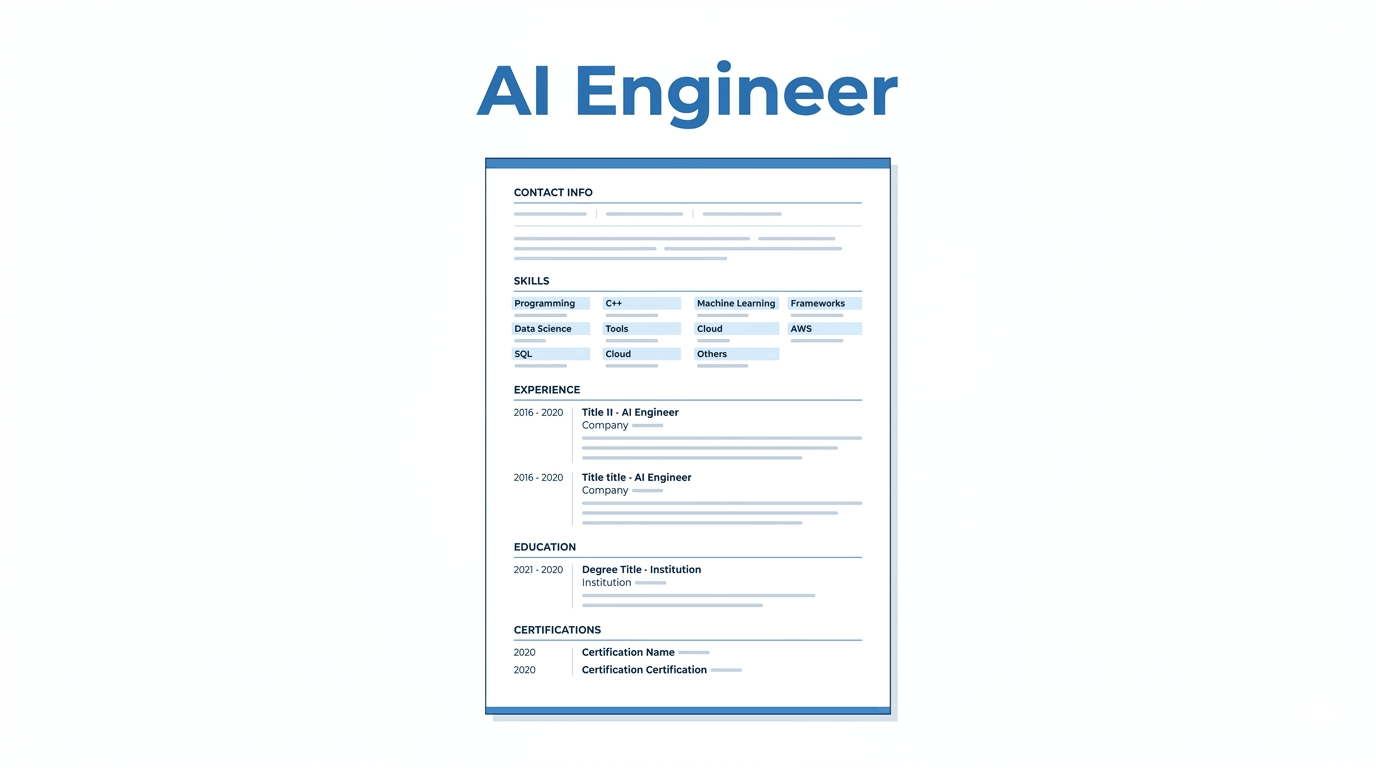
AI Engineer Resume Template
[Your Full Name] [City, Country] · [[email protected]] · [LinkedIn URL] · [GitHub URL] · [Portfolio or Hugging Face URL, optional]
Professional Summary
AI Engineer with [X] years of experience designing, training, and deploying [type of models — LLMs / computer vision / recommendation systems / multimodal models] at scale. Proficient in [PyTorch / TensorFlow / JAX] and experienced with [LLM fine-tuning / RAG pipelines / MLOps / generative AI applications]. Track record of building production AI systems handling [X] requests per day with [X]% uptime, reducing model inference latency by [X]%, and cutting infrastructure costs by [X]%. [Relevant certification — e.g. AWS Certified Machine Learning Specialty / Google Professional ML Engineer — match to job description.]
Skills
AI/ML Frameworks: PyTorch, TensorFlow, JAX, Hugging Face Transformers, LangChain, LlamaIndex, scikit-learn, XGBoost LLM & Generative AI: GPT-4, Claude, Llama, Mistral, Gemini, fine-tuning (LoRA, QLoRA, PEFT), prompt engineering, RAG, vector databases MLOps & Infrastructure: MLflow, Weights & Biases, Kubeflow, Airflow, Docker, Kubernetes, CI/CD pipelines Cloud Platforms: AWS (SageMaker, Bedrock, EC2), Google Cloud (Vertex AI, BigQuery), Azure (Azure ML, OpenAI Service) Vector Databases & Search: Pinecone, Weaviate, Chroma, FAISS, Elasticsearch Programming Languages: Python, SQL, Bash; familiarity with C++, Rust, or Go (match to JD) Data & Processing: Spark, Kafka, dbt, Pandas, NumPy, Ray Core Competencies: Model evaluation, A/B testing, responsible AI, model compression, inference optimization, system design
Work Experience
[Job Title] — [Company Name], [City] | [Month Year] – Present
- Designed and deployed [type of model — LLM / CV / recommendation] serving [X]M+ requests per day with [X]ms average latency and [X]% uptime
- Fine-tuned [model — e.g. Llama 3, Mistral] using [LoRA / QLoRA / PEFT] on [X]GB proprietary dataset, achieving [X]% improvement on [benchmark / internal evaluation metric]
- Built end-to-end RAG pipeline using [LangChain / LlamaIndex] with [Pinecone / Weaviate] vector store, reducing hallucination rate by [X]% and improving retrieval precision to [X]%
- Reduced model inference latency by [X]% through [quantization / distillation / ONNX export / TensorRT optimization], saving [$X] monthly in compute costs
- Collaborated with [X] cross-functional stakeholders across [product / data science / platform engineering] to ship [feature / product] from prototype to production in [X] weeks
[Job Title] — [Company Name], [City] | [Month Year] – [Month Year]
- Built and maintained [X] ML pipelines using [Kubeflow / Airflow / MLflow] processing [X]TB of data daily
- Developed model monitoring and drift detection system, reducing model degradation incidents by [X]%
- Conducted [X] A/B experiments on production models, driving [X]% improvement in [key business metric]
- Containerized ML workloads using Docker and Kubernetes, reducing deployment time from [X] hours to [X] minutes
- Documented model cards, evaluation frameworks, and responsible AI guidelines adopted across [X] teams
Education
[Degree] in [Field of Study — e.g. Computer Science, Machine Learning, Mathematics, Electrical Engineering] — [University Name], [Year]
Certifications
- AWS Certified Machine Learning – Specialty — Amazon Web Services
- Google Professional Machine Learning Engineer — Google Cloud
- Deep Learning Specialization — Coursera / DeepLearning.AI (if applicable)
- LLM Engineering Certificate — [Provider] (if applicable)
- [Other relevant certification]
Key ATS Keywords for AI Engineer Roles
The following are the most frequently required keywords in 2026 AI Engineer job descriptions across industries. Include only those that genuinely reflect your experience, and use the exact phrasing from the job description wherever possible.
Frameworks & Libraries: PyTorch, TensorFlow, JAX, Hugging Face, Transformers, LangChain, LlamaIndex, scikit-learn, XGBoost, Keras
LLM & Generative AI: LLM, large language model, fine-tuning, LoRA, QLoRA, PEFT, prompt engineering, retrieval-augmented generation, RAG, embeddings, vector search, generative AI, GPT, Claude, Llama, Mistral, multimodal
MLOps & Deployment: MLflow, Weights & Biases, Kubeflow, Airflow, Docker, Kubernetes, CI/CD, model serving, TorchServe, Triton Inference Server, ONNX, TensorRT
Cloud & Infrastructure: AWS SageMaker, Google Vertex AI, Azure ML, Bedrock, Lambda, EC2, GCS, S3
Vector Databases: Pinecone, Weaviate, Chroma, FAISS, pgvector, Milvus, Elasticsearch
Evaluation & Safety: model evaluation, benchmarking, RLHF, RLAIF, responsible AI, bias detection, model monitoring, data drift, hallucination reduction
Core Competencies: distributed training, inference optimization, model compression, quantization, knowledge distillation, system design, A/B testing, data pipelines
How to Tailor This Template to a Specific Job
AI Engineer roles vary significantly by company size, product focus, and technical stack. A template is a starting point — every version of your resume needs to be aligned to the specific role you are applying to. Here is how to do it efficiently:
1. Match their stack precisely. If the job says “PyTorch and Hugging Face”, lead with those. If it says “TensorFlow and Vertex AI”, adjust accordingly. Do not list every framework you have ever touched — prioritize the stack the employer is using in production.
2. Specify the model types they care about. An LLM-focused role and a computer vision role require completely different resume emphasis. Mirror the model types, architectures, and use cases mentioned in the job description.
3. Quantify infrastructure scale. Hiring managers at AI-forward companies care about scale: how many requests per second, how many parameters, how much data, what latency targets. Every bullet should have at least one concrete number.
4. Match their deployment environment. Cloud provider specificity matters. “AWS SageMaker and Bedrock” is far stronger than “cloud platforms”. Identify the cloud stack from the JD and make sure your experience with it is explicit.
5. Surface relevant open-source contributions. AI Engineer roles increasingly value GitHub activity, Hugging Face model contributions, and published work. Reference your GitHub URL and any notable repos or model cards in your summary if they are relevant.
This process takes 30–60 minutes manually. CVjustify does it automatically — paste your resume and the job description, and it rewrites and aligns the full document in seconds.
Common AI Engineer Resume Mistakes
No infrastructure or scale numbers. An AI Engineer resume without mentions of model size, inference latency, data volumes, or request throughput leaves hiring managers without the signal they need. They are not hiring researchers — they are hiring engineers who can ship reliable AI systems at scale.
Listing tools without outcomes. “Used PyTorch to train models” describes a tool. “Reduced training time by 60% by migrating from single-GPU to distributed training with PyTorch DDP across 8 A100s” describes engineering judgment. Every bullet should reflect what you built and what improved as a result.
Confusing research and engineering. AI Engineer roles are production-oriented. If your experience is primarily academic or research-focused, translate it: publications become deployed systems, experiments become A/B tests, datasets become data pipelines. Hiring managers want to see that you can take models to production.
Missing MLOps depth. Many candidates list ML frameworks but omit the operationalization layer — model monitoring, CI/CD for ML, drift detection, feature stores. In 2026, this gap is a red flag for senior AI Engineer roles. If you have MLOps experience, make it explicit.
Generic summary without a specialization. “Experienced AI Engineer with strong machine learning skills” could describe anyone. Your summary should specify your domain (LLMs, CV, speech, recommendations), your stack, and the scale at which you have worked.
Frequently Asked Questions
Do I need a PhD to get an AI Engineer role?
No — AI Engineer is an engineering role, not a research role. Strong production experience with ML frameworks, MLOps, and demonstrated delivery of AI systems at scale is what most companies are hiring for. A PhD can strengthen a research-adjacent AI Engineer role, but the majority of AI Engineer job descriptions do not require one.
How long should an AI Engineer resume be?
One to two pages depending on experience. For engineers with fewer than 7 years of experience, aim for one page. Senior AI Engineers with extensive project history, open-source contributions, or publications can justify two pages. Never exceed two pages for most commercial roles.
Should I tailor my AI Engineer resume for each application?
Yes — more so than almost any other engineering role. AI Engineer job descriptions vary significantly by company focus (LLMs vs. CV vs. recommendations), deployment environment (cloud provider, edge, on-premise), and technical stack. A resume tailored for an LLM application role will underperform when applied to a computer vision infrastructure role without adjustment.
What is more important — ML knowledge or engineering skills?
Both are required, but the balance shifts by role. For AI Engineer (as distinct from ML Research Scientist), production engineering skills — MLOps, system design, inference optimization, scalable data pipelines — are increasingly weighted alongside modeling ability. Roles explicitly titled “AI Engineer” or “ML Engineer” prioritize the engineering half; roles titled “Applied Scientist” prioritize the research half.
How do I make my AI Engineer resume pass ATS?
Use a clean single-column layout with no tables, text boxes, or images. Include the exact framework, model, platform, and tool names from the job description. Use standard section headers: Work Experience, Skills, Education, Certifications. Quantify every bullet point with concrete performance numbers. Save as PDF or DOCX.