
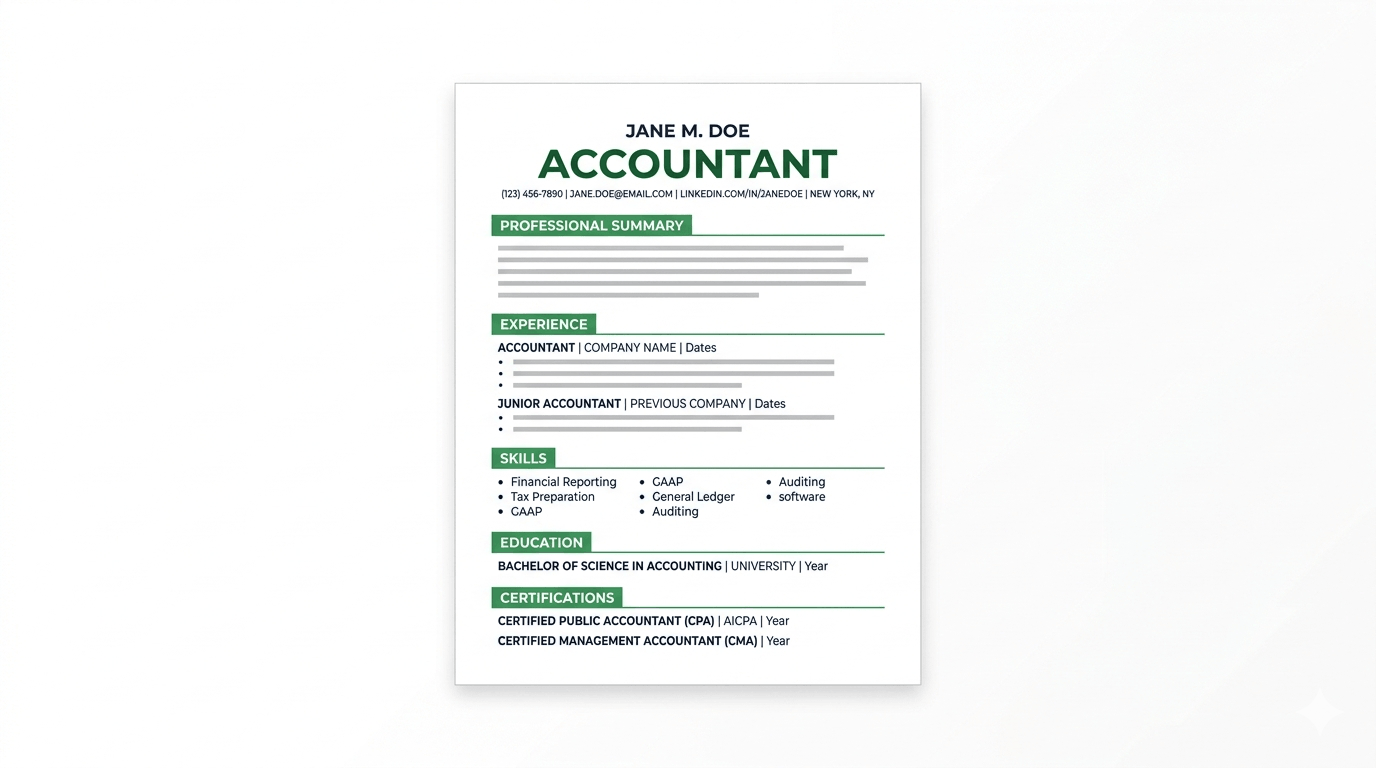
Accounting roles are among the most searched and most consistently in-demand positions across every industry. The title spans public accounting, corporate finance, tax, audit, management accounting, and beyond — which means the applicant pool is enormous and ATS filters are configured to match very specific credentials and technical skills. A resume that lists “strong Excel and financial skills” where the job description asks for “CPA, GAAP, reconciliations, and ERP proficiency in SAP or Oracle” will be filtered out before a recruiter ever sees it.
This template is built around how accountant roles are actually screened in 2026: certification verification, software-specific keyword matching, and hiring managers who decide in seconds whether your experience maps to their financial reporting and compliance requirements.
What Makes an Accountant Resume ATS-Ready
ATS systems for accounting roles filter on a combination of certifications, software platforms, accounting standards, and domain-specific terminology. “Handled financial records” fails. “Managed full-cycle accounts payable and receivable for a $50M revenue business, reconciling 500+ monthly transactions with zero discrepancies over 18 months” passes. Every certification, ERP system, accounting standard, and core competency needs to be named precisely — and matched to the language of the job description you are applying to.
Formatting matters equally. Tables, columns, text boxes, and graphics break ATS parsing even when your content is strong. The template below uses a clean single-column layout that parses reliably across Workday, Greenhouse, Lever, iCIMS, and all other major ATS platforms.
Accountant Resume Template
[Your Full Name] [City, Country] · [[email protected]] · [LinkedIn URL] · [CPA License Number or State, optional]
Professional Summary
[CPA / CMA / ACCA — match to job description] with [X] years of experience in [public accounting / corporate accounting / tax / audit / management accounting]. Proven track record of managing [full-cycle accounting / financial reporting / tax compliance / audit engagements] for organizations with revenues up to [$X]. Proficient in [SAP / Oracle / QuickBooks / NetSuite — match to JD] and experienced in [GAAP / IFRS / SOX compliance]. Known for delivering accurate, timely financial statements and identifying process improvements that reduce close time and operational costs.
Skills
Accounting & Finance: General ledger, accounts payable, accounts receivable, bank reconciliation, financial reporting, month-end close, year-end close, budgeting, forecasting, variance analysis Standards & Compliance: GAAP, IFRS, SOX compliance, internal controls, tax compliance, audit preparation ERP & Accounting Software: SAP, Oracle Financials, QuickBooks, NetSuite, Microsoft Dynamics, Xero, Sage Reporting & Analysis: Excel (VLOOKUP, pivot tables, macros), Power BI, Tableau, financial modeling Certifications & Designations: CPA, CMA, ACCA, CFA (match to your actual credentials) Core Competencies: Financial analysis, cost accounting, payroll processing, fixed asset management, intercompany reconciliation, audit support, cash flow management
Work Experience
[Job Title] — [Company Name], [City] | [Month Year] – Present
- Managed full-cycle accounting for a [$X] revenue organization, including GL maintenance, AP/AR, bank reconciliations, and month-end close completed within [X] business days
- Prepared and presented monthly, quarterly, and annual financial statements in accordance with [GAAP / IFRS], with zero material audit findings over [X] years
- Reduced month-end close cycle from [X] days to [X] days by streamlining reconciliation processes and implementing automated journal entry workflows in [SAP / NetSuite / Oracle]
- Led annual external audit coordination, preparing [$X] in supporting schedules and responding to [X]+ auditor requests with zero restatements
- Identified and corrected [$X] in cost allocation errors through variance analysis, improving budget accuracy by [X]%
[Job Title] — [Company Name], [City] | [Month Year] – [Month Year]
- Processed [X]+ vendor invoices monthly with [X]% on-time payment rate, maintaining strong vendor relationships and capturing [$X] in early-payment discounts
- Reconciled [X] bank accounts and [X] balance sheet accounts monthly, resolving discrepancies within [X] business days
- Assisted in preparation of corporate tax returns ([federal / state / VAT / GST]) with [$X] in tax liability accurately reported
- Supported SOX compliance testing across [X] key controls, with zero control deficiencies identified during external review
- Mentored [X] junior accountants on general ledger processes, reducing onboarding time by [X]%
Education
[Degree] in [Field of Study — e.g. Accounting, Finance, Business Administration] — [University Name], [Year]
Certifications
- Certified Public Accountant (CPA) — [State Board of Accountancy]
- Certified Management Accountant (CMA) — IMA (if applicable)
- ACCA (Association of Chartered Certified Accountants) (if applicable)
- Chartered Financial Analyst (CFA) — CFA Institute (if applicable)
- [Other relevant certification — e.g. QuickBooks ProAdvisor, SAP FI certification]
Key ATS Keywords for Accountant Roles
The following are the most frequently required keywords in 2026 accountant job descriptions across industries. Include only those that genuinely reflect your experience, and use the exact phrasing from the job description wherever possible.
Accounting Functions: General ledger (GL), accounts payable (AP), accounts receivable (AR), bank reconciliation, journal entries, month-end close, year-end close, trial balance, fixed assets, depreciation, accruals, payroll
Standards & Compliance: GAAP, IFRS, SOX, internal controls, audit, tax compliance, VAT, GST, transfer pricing, revenue recognition, ASC 606, lease accounting, ASC 842
ERP & Software: SAP, Oracle, NetSuite, QuickBooks, Microsoft Dynamics, Xero, Sage, BlackLine, Concur, Workday Financials
Reporting & Analysis: Financial statements, balance sheet, income statement, cash flow statement, variance analysis, financial modeling, budgeting, forecasting, KPIs, management reporting
Certifications: CPA, CMA, ACCA, CFA, CAPM, QuickBooks ProAdvisor, SAP FI
Soft Skills from JDs: Attention to detail, analytical thinking, cross-functional collaboration, stakeholder communication, process improvement, deadline management
How to Tailor This Template to a Specific Job
Accounting roles vary significantly by sector, company size, and specialization. A template is a starting point — every version of your resume needs to be aligned to the specific role you are applying to. Here is how to do it efficiently:
1. Match their accounting specialization. Public accounting, corporate accounting, tax, and audit roles each require a different emphasis. If the job is AP/AR-focused, lead with transactional volume and accuracy. If it is financial reporting, lead with close cycle management and audit-readiness.
2. Use their exact software names. “Accounting software” fails where “NetSuite and BlackLine” passes. Mirror the specific ERP and tools mentioned in the job description.
3. Reference their compliance requirements. SOX, GAAP, IFRS, VAT, and ASC standards are not interchangeable. Identify which standards the employer operates under and make sure your experience with them is explicit.
4. Quantify everything. Accounting bullet points without numbers are weak. Transaction volumes, close cycle days, audit findings, cost savings, variance percentages — every bullet should have at least one metric.
5. Surface your certifications prominently. If the job requires CPA, make sure it appears in your summary, certifications section, and ideally in the context of at least one bullet point. Certification-first employers often filter before reading experience.
This process takes 30–60 minutes manually. CVjustify does it automatically — paste your resume and the job description, and it rewrites and aligns the full document in seconds.
Common Accountant Resume Mistakes
No transaction volumes or financial figures. An accountant resume without dollar amounts, transaction counts, or close cycle times leaves hiring managers without the scale context they need. Did you manage $500K in payables or $500M? That distinction matters enormously.
Listing duties instead of outcomes. “Responsible for month-end close” describes a job function. “Reduced month-end close from 10 days to 5 days by automating recurring journal entries in NetSuite, freeing 20 hours of team capacity monthly” describes performance. Every bullet should reflect what you achieved, not what your job was.
Ignoring software specificity. Accounting is one of the most software-specific fields in hiring. “Proficient in accounting software” is meaningless. Name the exact ERP, version if relevant, and the modules you worked in (e.g. SAP FI/CO, Oracle AP, NetSuite SuiteGL).
Omitting compliance context. SOX experience, audit support, and internal controls are significant differentiators for mid-to-senior accounting roles. If you have them, make them explicit — do not bury them in a generic bullet.
Generic summary without specialization. “Detail-oriented accountant with strong analytical skills” could describe anyone. Your summary should specify your accounting domain, the scale of organizations you have supported, and the standards and systems you work in.
Frequently Asked Questions
Do I need a CPA to get an accounting job?
Not always — but it is the most recognized credential in the field and is required or strongly preferred for senior accountant, controller, and public accounting roles. For staff accountant and bookkeeping roles, it is often not required. For roles in management accounting, a CMA can be an effective alternative.
How long should an accountant resume be?
One to two pages depending on experience. For accountants with fewer than 8 years of experience, aim for one page. Senior accountants, controllers, and finance managers with extensive audit, ERP implementation, or public accounting experience can justify two pages. Never exceed two pages.
Should I tailor my accountant resume for each application?
Yes. Accounting roles vary significantly by industry (public vs. corporate), specialization (tax vs. audit vs. GL), and company size. A resume tailored for a Big Four audit role will perform poorly when applied to an in-house corporate accounting role without significant adjustment.
What is more important on an accounting resume — certifications or experience?
Experience with quantified outcomes outweighs certifications in most cases, particularly for mid-career roles. A CPA signals technical credibility, but bullet points showing you managed a $100M close cycle with zero audit findings are what get interviews. Lead with experience, support with certifications.
How do I make my accountant resume pass ATS?
Use a clean single-column layout with no tables, text boxes, or images. Include the exact ERP names, accounting standards, and certification designations from the job description. Use standard section headers: Work Experience, Skills, Education, Certifications. Quantify every bullet point with dollar amounts, percentages, or time metrics. Save as PDF or DOCX.