Most job seekers either skip the cover letter entirely or spend an hour writing one that sounds like everyone else’s. Neither approach works.
A cover letter is not just a formality. When written well, it is the fastest way to tell a recruiter something your resume cannot: why you want this role, at this company, and why you are the right fit — in your own voice.
The problem is that writing a great cover letter from scratch, for every application, is genuinely time-consuming. That is where AI cover letter generators come in. But not all AI-generated cover letters are created equal — and a bad one can do more damage than no cover letter at all.
This guide explains what makes a cover letter work, how AI can help, and how to use it without sounding like a robot.
Why Most Cover Letters Fail
Before understanding how to write a good cover letter, it helps to understand why most of them fail.
They are generic. Recruiters read hundreds of cover letters. One that opens with “I am writing to express my interest in the position of…” signals immediately that the writer did not put in real effort. It is the cover letter equivalent of a copy-paste.
They repeat the resume. A cover letter that simply summarizes what is already on your resume adds no value. The recruiter has your resume. The cover letter should add something new — context, motivation, or a specific example that did not fit in a bullet point.
They focus on the applicant, not the employer. The most common cover letter mistake is making it entirely about what you want. Recruiters care about what you can do for them. A strong cover letter bridges the two: here is what I have done, here is why it matters for your specific situation.
They are too long. Three to four short paragraphs is enough. A cover letter that runs to a full page or more rarely gets read in full.
What a Strong Cover Letter Actually Looks Like
A cover letter that gets results typically does five things:
- Opens with a specific hook — something that shows you know the company or role, not a generic opener
- Connects your experience to their needs — two or three sentences that map your background directly to what the job posting is asking for
- Adds something the resume cannot — a brief story, a specific result, or a clear statement of why this role matters to you
- Uses the employer’s language — mirrors the keywords and tone of the job description
- Closes with a clear call to action — a confident, direct sentence expressing your interest in a conversation
That structure is simple. Executing it well for every application is the hard part — which is exactly what AI can help with.
How AI Cover Letter Generators Work
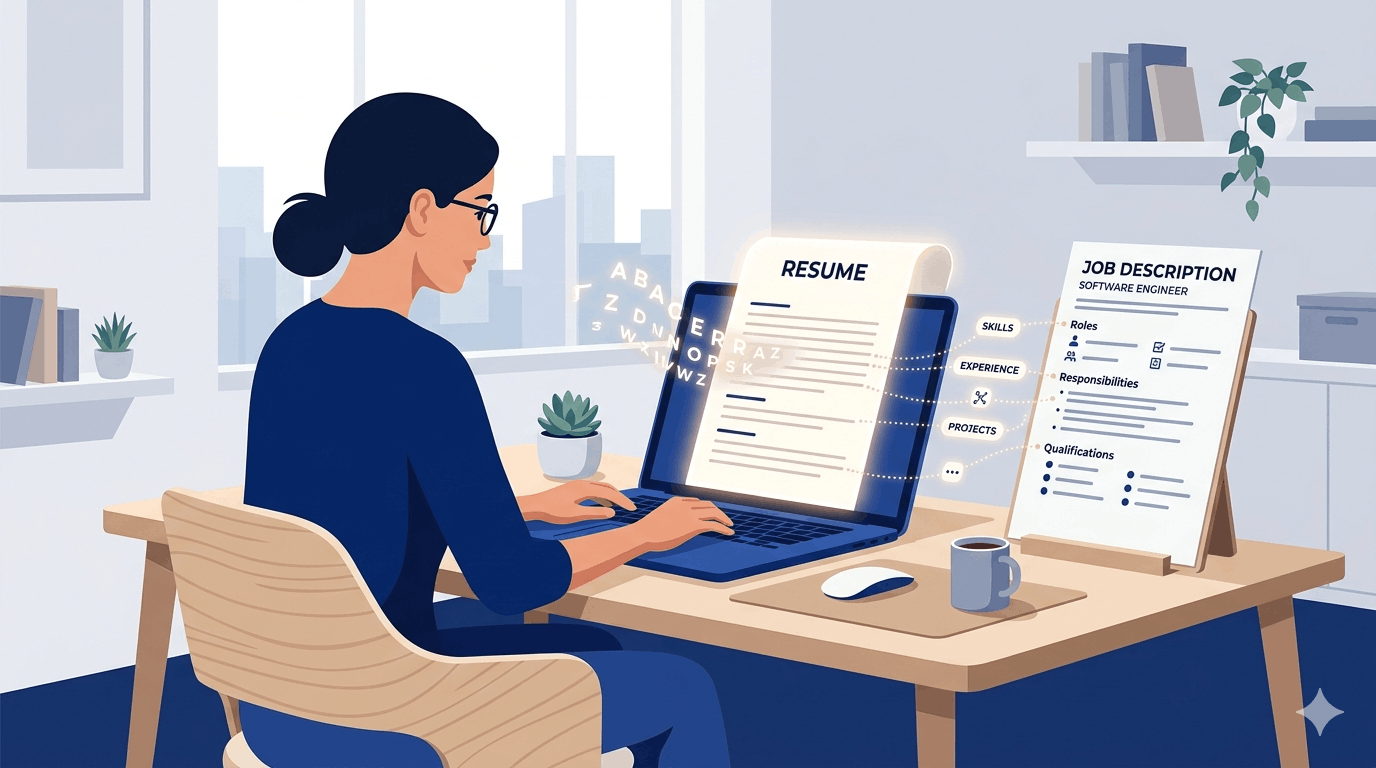
AI cover letter generators use large language models to draft a cover letter based on inputs you provide — typically your resume, the job description, and sometimes a few personal notes about why you want the role.
The best tools do more than fill in a template. They:
- Analyze the job description for the role’s key requirements, tone, and priorities
- Match your experience from your resume to what the employer is looking for
- Draft a cover letter in a natural, professional voice that sounds specific to you and the role
- Incorporate keywords from the job description to improve relevance
- Adapt the tone to match the company — formal for a law firm, conversational for a startup
The output is a starting point, not a finished product. The best approach is to use AI to generate a strong first draft, then personalize it with details only you would know — a conversation you had at a company event, a specific project you worked on, a reason the company’s mission resonates with you.
AI Cover Letter vs. Writing from Scratch: What Actually Saves Time
Here is an honest comparison:
| Writing from scratch | Using AI | |
|---|---|---|
| Time per cover letter | 45–90 minutes | 5–10 minutes |
| Keyword alignment | Depends on effort | Automatically matched |
| Personalization | High (if you put in the work) | Medium (requires your input to lift it) |
| Risk of generic output | High (without a strong template) | Low (with a good tool and your edits) |
| Consistency across applications | Hard to maintain | Easy to maintain |
The biggest gain is not just speed — it is consistency. When you are applying to ten or twenty roles, maintaining quality across every cover letter is exhausting manually. AI makes it possible to produce a tailored, well-structured letter for every application without the quality dropping off.
How to Use an AI Cover Letter Generator Effectively
AI does the heavy lifting. Your job is to give it good inputs and refine the output.
Step 1: Paste the Full Job Description
Do not summarize it. Give the AI the complete job posting, including the responsibilities, requirements, and any information about the company culture. The more context, the better the output.
Step 2: Upload or Paste Your Resume
The AI needs to know your actual background to match it to the role. A complete, up-to-date resume gives the tool more to work with — and produces a more specific, credible cover letter.
Step 3: Add a Personal Note (Optional but Valuable)
If you have a specific reason for wanting this role — a connection to the company’s mission, a project that directly relates to what they are building, or a person you spoke to — add it as a note. Even one sentence of genuine context transforms the output.
Step 4: Review and Personalize
Read the draft carefully. Ask yourself:
- Does this sound like me?
- Does it add anything my resume does not already say?
- Is there anything generic that I can replace with something specific?
Edit accordingly. The goal is a letter that reads as if you wrote it — because, in the end, you did.
Step 5: Check the Length and Tone
Aim for three to four paragraphs and no more than 350 words. Read it aloud. If it sounds stiff or corporate, loosen it. If it sounds too casual for the role, tighten it.
Common AI Cover Letter Mistakes to Avoid
Using the output without editing it. An unedited AI cover letter is obvious to experienced recruiters. The phrasing is often slightly too smooth, slightly too generic, and missing the specific details that make a letter convincing.
Forgetting to remove placeholder text. Some AI tools leave bracketed placeholders like [Company Name] or [Specific Achievement]. Always read the full output before submitting.
Making it too long. AI tools sometimes err on the side of being thorough. Cut anything that does not add value. Recruiters do not need to read your full career history in the cover letter — they have your resume.
Ignoring tone. A cover letter for a creative agency should sound different from one for a law firm. Make sure the AI output matches the culture of the company you are applying to.
Sending the same letter to multiple employers. Even if you are using AI, each cover letter should be tailored to the specific role and company. A letter addressed to the wrong company — or with mismatched details — signals carelessness.
How CVjustify Generates Cover Letters
CVjustify generates cover letters by analyzing both your resume and the job description simultaneously. It identifies the overlap between your background and the role’s requirements, matches the language of the job posting, and drafts a letter that reads as specific and motivated — not templated.
The process takes under a minute. The output is a tailored first draft that you can review, edit, and send — without spending an hour staring at a blank page.
It also works alongside the resume tailoring feature, so your cover letter and resume are aligned in language, emphasis, and tone before you submit.
Frequently Asked Questions
Do recruiters actually read cover letters?
It depends on the company and the recruiter. Many recruiters say they read cover letters when they are deciding between two similarly qualified candidates — which means a strong cover letter can be the deciding factor. A weak or generic one, however, rarely helps and can hurt.
Should I always include a cover letter?
Unless the job posting explicitly says not to, yes. Including a tailored cover letter shows effort and gives you an additional opportunity to make your case. The risk of including one is low; the potential upside is meaningful.
How long should a cover letter be?
Three to four paragraphs, ideally under 350 words. Recruiters do not read cover letters the way they read novels — they skim them. Keep it focused and easy to scan.
Can AI write a cover letter that sounds like me?
Yes — with the right inputs and your edits. The AI produces a strong structural draft. Your job is to add the specific details, tone adjustments, and personal touches that make it sound genuinely like you. Five minutes of editing makes a significant difference.
Is it dishonest to use AI for a cover letter?
No. Using AI to draft a cover letter is similar to using a writing tool, a template, or asking a mentor to review your draft. The ideas, experience, and intent are yours. The AI helps you express them more efficiently. What matters is that everything in the letter is accurate and reflects your genuine interest in the role.
What information do I need to generate a cover letter with AI?
At minimum: the job description and your resume. Adding a brief personal note about why you want the role — even just one or two sentences — significantly improves the output.